
The Forward Cap Portfolio

Today’s post is about a new portfolio from Cullen Roche called the Forward Cap Portfolio.
Contents
Your Perfect Portfolio
The Forward Cap Portfolio (FCP) is taken from a recent book by Cullen Roche, whom we’ve come across many times previously on the blog.
- Cullen rose to fame with some papers about how modern economies work.
He’s particularly keen on the distinction between saving (what we private investors do to protect our futures) and investment (what firms do to increase their productivity).
- He also points out that no one is truly passive – we all make choices with our money.
He has put forward the Global Cap portfolio (GFAP), a truly passive portfolio which reflects all investable assets.
- I think that’s a nice idea, but it includes too many bonds, and therefore has too low a rate of return.
The FCP is a spin on the GFAP that takes account of mega-trends.

Cullen’s book is well worth a read, but I wish it had been published ten years earlier.
- It covers twenty-odd approaches to portfolio construction, the vast majority of which we’ve stumbled across during the thirteen years of this blog.
You may have noticed that the book’s title is very close to my own use of The Perfect Portfolio for my target allocation, but Cullen is very much of the opinion that everyone needs to figure out their own ideal allocation.
- That sounds like a good approach, but in practice I think that people use this reasoning to support a lot of sub-optimal allocations.
- The best portfolio is one that you can stick to, but for most people, the best allocation is likely to be pretty close to what I would call the Perfect Portfolio.
I didn’t want to not write about the book at all, so I’ve chosen the portfolio that I think can bring something to my own allocation.
The Forward Cap Portfolio
The book is styled as a tour of all the portfolios that Cullen has tried out at some point in his investing (saving) career, but he admits that he hasn’t yet used the FCP in anger.
If the GFAP is the efficient market portfolio, or the portfolio that “takes what the market gives us,” then the Forward Cap Portfolio could be thought of as the portfolio that tries to “skate to where the puck is going.”
The GFAP is based on the current market cap of existing stocks and bonds, while the Forward Cap Portfolio is an estimate, based on macroeconomic trends, of what future market capitalisation might look like.
So it’s all about extrapolating trends.
Since Cullen hasn’t used the FCP, he can’t provide a backtest for it (he doesn’t have decades of trend forecasts to compare with reality).
- But we can reasonably assume that if enough of your trend predictions come true, the portfolio should outperform.
At the same time, this is a very active and risky approach, and so more suitable for a small satellite portfolio than your core allocation.
- Cullen notes that it is a pure stock portfolio and so shouldn’t be used standalone.
Five Trends
Cullen has chosen five trends that he thinks will have the greatest influence on future market capitalisation:
- Technology is eating the world.
- Human beings are eating the world. We will need an ever-increasing industrial footprint to meet the growing supply needs of this consumption, and we will see more discretionary consumer spending.
- Emerging markets are eating the world. Emerging markets are likely to become developing markets that overtake older more developed economies like Europe and the US.
- Healthcare is eating the eaters. Capitalism has done an incredible job bringing people out of poverty, but it often creates this massive low-cost food supply with no regard for the quality of that food supply. Obesity rates and chronic illnesses are on the rise. The demand for healthcare and biotechnology is likely to grow.
- Decentralization is eating centralization. As global networks expand, individuals and small organizations can more easily access resources and scale their operations. Entrepreneurship and decentralization is likely to boom over time.
Tech
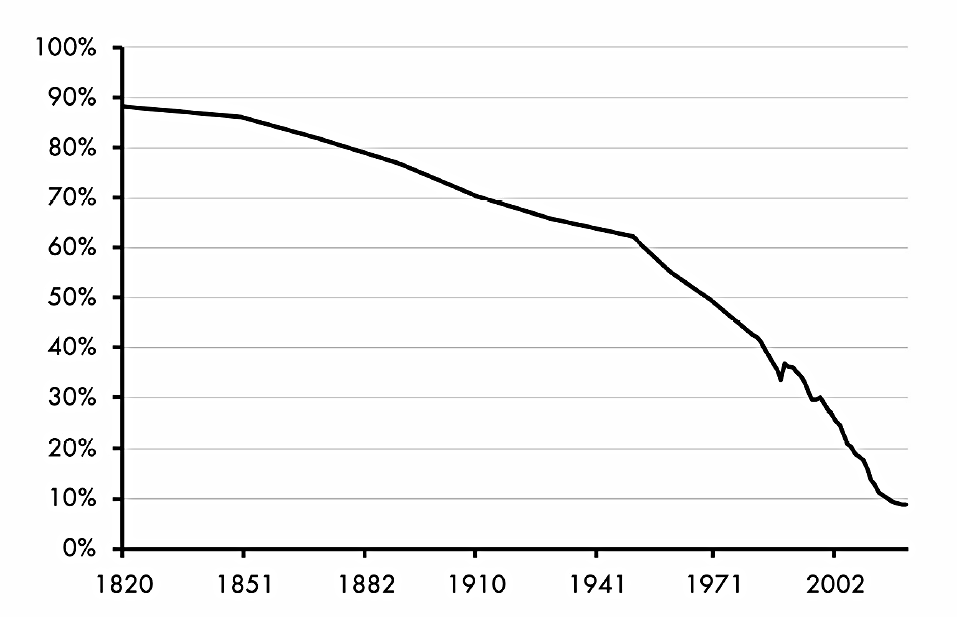
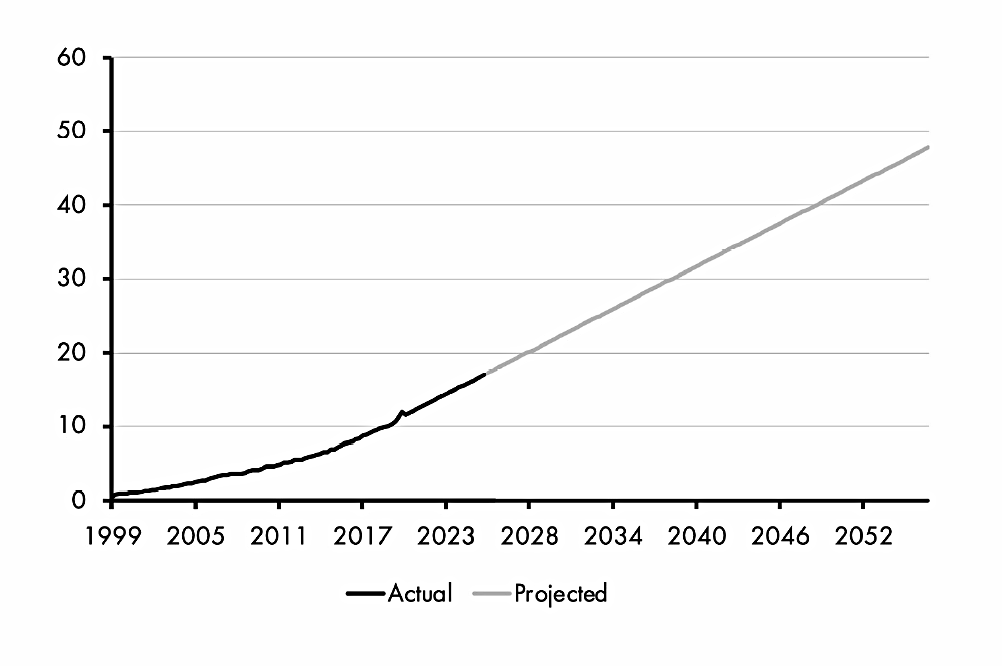
To extrapolate the impact of tech, Cullen looks at e-commerce sales as a percentage of retail sales.
- This has gone from 0% in 1999 to 15% in 2025.
- Cullen expects it to reach 45% in 2056.
Tech currently accounts for 28% of the All World Index, and he expects this to rise to more than 40%.
- He also expects tech firms to become more global.
He uses a 40% allocation, split between the US and Global (using US ETFs):
- 20% Vanguard Information Technology (ticker: VGT)
- 20% iShares Global Tech ETF (ticker: IXN)
You could also throw in AI and robotics ETFs here.
Cullen also notes that tech is disinflationary and we could expect ZIRP to return.
Human Beings
Rising population and wealth will mean more consumer spending on non-essentials.
In the developed world personal consumption makes up 68% of GDP. But in the major emerging markets it comprises just 47%. I expect these figures to converge. We could see a 40%+ change in the current weighting of emerging market consumption.
Consumer Discretionary currently has a 10% global weighting today, but Cullen will use a 14% future weighting, again split between US and foreign firms:
- 7% Vanguard Consumer Discretionary ETF (ticker: VCR)
- 7% iShares Foreign Consumer Discretionary ETF (ticker: RXI)
Developed-market consumers help drive growth and wealth convergence in the emerging world by buying the goods that fuel emerging market output through international trade – making this a truly symbiotic relationship.
Emerging Markets
Cullen expects more globalisation (not sure I agree) and a diversification of reserve currencies (more plausible).
In the last 50 years we’ve begun to see the slow decline of reserve market share for the US dollar. It could decline to 50% with time. That shift would likely result in one or more emerging economies gaining 5–10% of the global reserve market share.
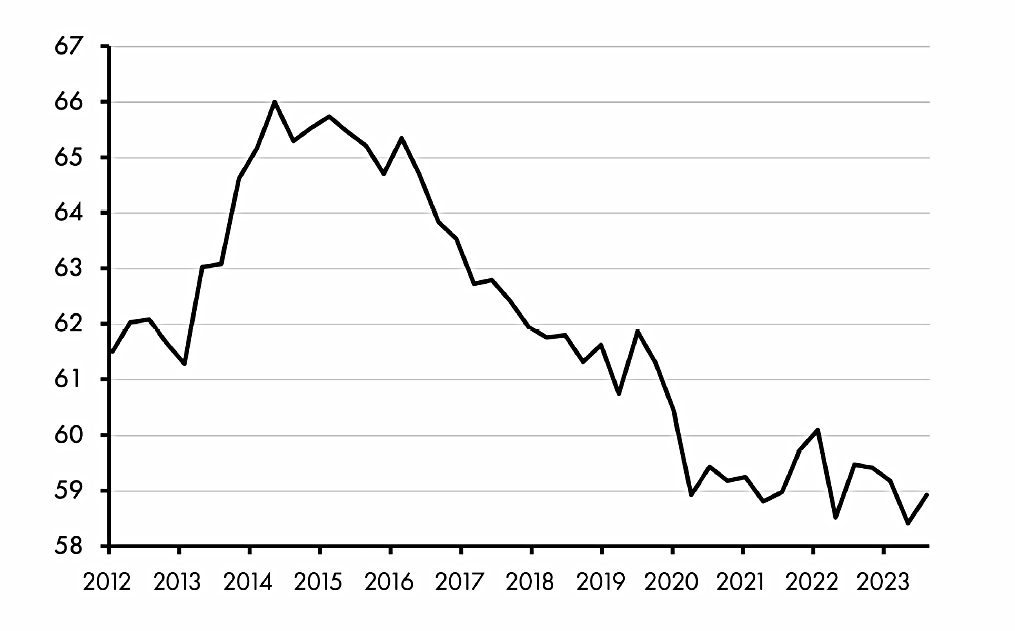
Cullen expects this to benefit firms in Asia, particularly China and India.
- They have a joint 5% weighting in the all-world index, and he expects this to rise to 15%.
Here, Cullen just uses a 15% geographical weighting to Emerging Markets (Vanguard Emerging Market ETF, ticker: VWO).
Healthcare
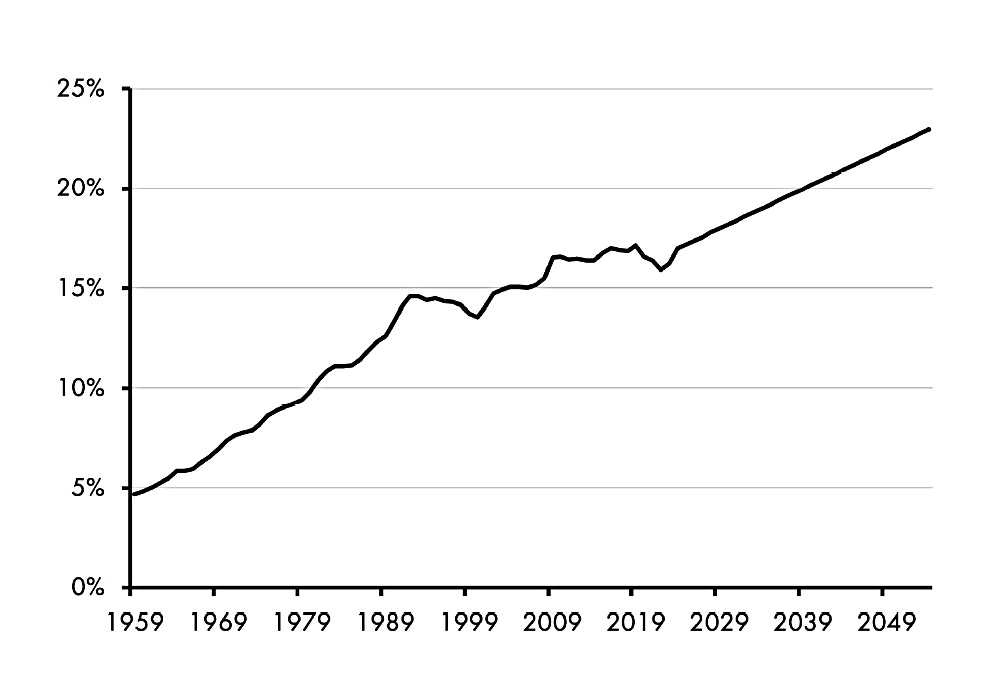
As global wealth increases, more people can afford better care while at the same time longer lifespans coupled with increasingly unhealthy lifestyles are driving greater demand for healthcare services.
Cullen expects healthcare to grow by 40% in the next 30 years, with the sector weighting increasing from 10% to 14%.
He plans to take advantage of healthcare and biotech funds:
Decentralization
This theme is about globalisation and technology empowering smaller (more agile) firms.
We want to tap into the smaller and faster growing firms that will become tomorrow’s giants. Ideally, this would be done using non-public venture capital firms, but we want this allocation to be easily accessible, so we’ll achieve this using publicly listed small cap stocks.
Small caps are 9% of today’s market and Cullen expects this to grow to 17%.
He will use a small-cap ETF for access – Vanguard Small Cap Growth, ticker: VBK.
Bitcoin
If you want to add an extra spicy element here, consider a small Bitcoin or blockchain ETF. But be very careful. They’re highly volatile so you’d want to maintain a small allocation and a consistently rebalanced position.

Backtest
Now that he has an allocation, Cullen can backtest.
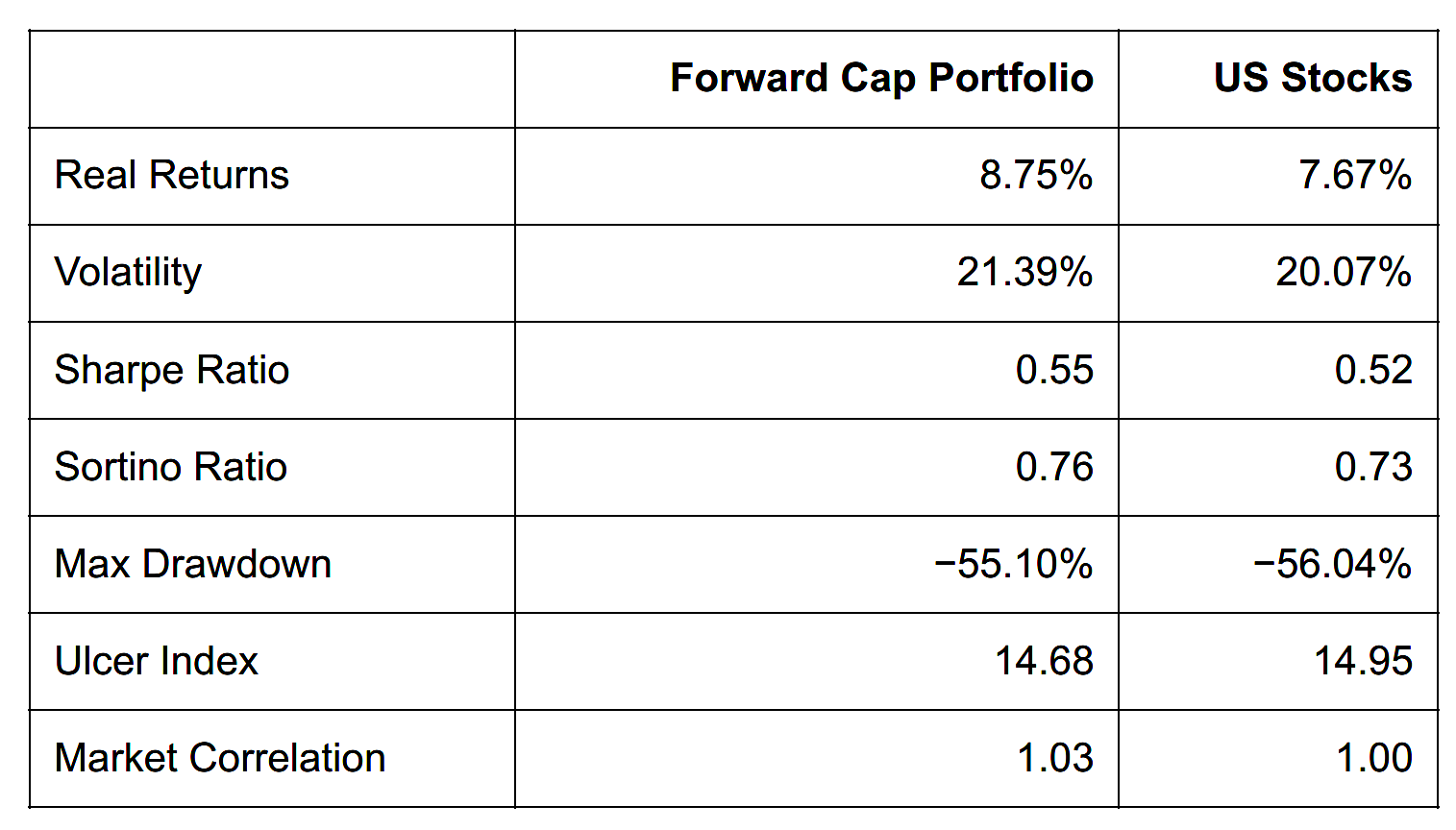
Had I been smart enough to put this portfolio together 20 years ago, it would have trounced both global and US stocks. I am not fitting the allocations to optimize the data relative to benchmarks. I constructed the model from the underlying empirical evidence and then applied it.

I’m not sure I would use the word “trounced”, but the FCP is a good portfolio:
- It beats US stocks by 1% pa with comparable volatility, drawdowns and ulcer index.
- And it does this with a much more global allocation during a period where US stocks have outperformed.
- It beats the global market by 3.5% pa with comparable volatility, lower drawdowns and a better Ulcer Index.
Implementation
The FCP is two-thirds thematic and one-third geographical / factor (small size).
- I have the EM and small-cap exposure covered off already, so I will focus on incorporating the mega-trend thematic ETFs into my 5% allocation to themes.
- All of the ETFs Cullen mentioned have UK (UCITS) equivalents, so this will be pretty easy.
Here’s my list for Mega Trend:
US IT – IITU
World IT – XXTW
US Consumer Discretionary – ICDU
World Consumer Discretionary – XWDS
Healthcare Innovation – DRDR
Nasdaq Biotech – BTEK
Blockchain – BCHS
That’s it for today.
- Until next time.
Mike Rawson

Mike is the owner of 7 Circles, and a private investor living in London. He has been managing his own money for 40 years, with some success.