
Innovation and Inflation

Contents
Innovation and Inflation
Today’s post looks at a recent paper from Goldman Sachs on how to balance Innovation and Inflation in portfolios
Balancing Innovation and Inflation
The Goldman (GS) paper is from July 2026 and is called Balancing Innovation and Inflation in Portfolios.
The backdrop to the paper is the strong performance of markets in general and stocks in particular since the 2022 crash.
- The equity risk premium is now up near that of the 1920s and 1950s, and a “World Portfolio” or US 60/40 has done well.

The AI boom has boosted Tech, and the World Portfolio is now dominated by US stocks and, in particular, Tech.
- The World Portfolio is driven by cycles of innovation, inflation and relative performance, and can be backwards-looking.
- It often drifts to high risk allocations just before structural breaks.

Innovation boosts stocks, particularly growth stocks and Tech, but:
The current AI capex boom increases the risk that falling profitability for mega-cap Tech stocks materially drags on equity returns before benefits from AI adoption show up.

GS provides a range of future macro scenarios to analyse.
In all but an optimistic ‘Goldilocks + AI boom’ scenario, expected long-term equity returns are below the long-run average.
GS recommends regularly rebalancing towards “regime-neutral” portfolios, which currently would mean fewer stocks and more real assets.

But in the short run (an equity bull market) leaning against momentum is costly (since stocks often do well right until the peak, and in particular the leading sector, in this case Tech).
Investors need to keep exposure to innovation, protect against inflation and improve risk mitigation – we recommend five strategies to stay invested while balancing innovation and inflation in global multi-asset portfolios.

Those are:
- selective real asset allocations
- opportunities in factors and style diversification
- regional diversification opportunities across assets
- option strategies such as long-dated calls and
- selective alternatives that are uncorrelated with the ‘World Portfolio’

Anatomy of a Bull Market
The rest of the paper fleshes out these points without adding anything dramatic, but it also contains a lot of interesting charts, so we’ll carry on with minimal commentary.
Balanced portfolios have delivered strong returns in recent years

One of the strongest bull markets in financial assets post-GFC, led by the US

US assets have become more dominant in the World Portfolio again

Equity risk premia have been among the strongest since the Golden 20s and 50s

Tech sector outperformance has been unusually strong and prolonged

Concentration in the US equity indices has increased alongside the Tech sector weight

Stock concentration has increased both in the US and, more recently, in EM benchmarks

Structural cycles
US 60/40 portfolio performance varied materially owing to structural cycles

[Balanced portfolios performed best in a structural ‘Goldilocks’ scenario with low inflation and good growth

Innovation has historically often conditioned the structural growth/inflation mix

Equities are expensive, bond yields near long-term average

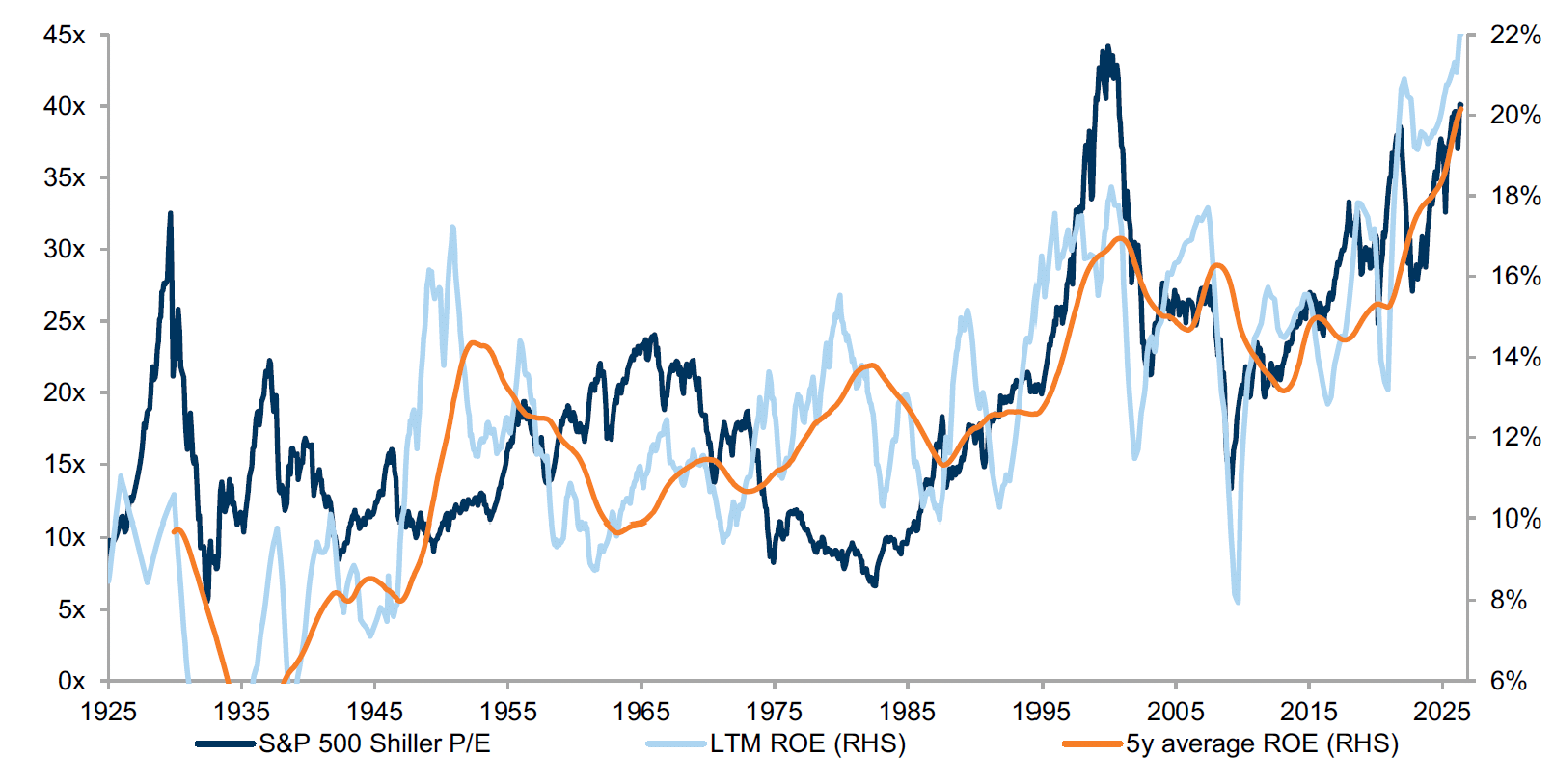
Rising ROEs have supported US equity valuations
S&P 500 earnings have accelerated in recent years and outstripped GDP growth

US TMT stocks are more profitable compared to the Tech Bubble and the rest of the market

AI Capex
AI capex spending from the hyperscalers has accelerated

AI hyperscaler capex creates headwinds to ROE

ROEs for Mega-cap tech stocks are expected to decline

Inflation
Anchored inflation near 2% has been most supportive for valuations

Bond yields track nominal growth

Low and anchored inflation has also supported higher equity valuations

Cycle Scenarios
The outlook for balanced portfolios in the coming years is closely linked to the AI boom and risks from inflation. We derive new scenarios using our macro-based long-term return framework from Global Strategy Paper: The Strategic Balanced Bear.
- Goldilocks + AI boom, with continued ROE expansion and strong GDP growth
- Goldilocks, but with stable ROE
- Reflation, with strong nominal growth but lower ROE
- Goldilocks + AI bust, in which ROE declines and GDP growth weakens
- Stagnation, with weaker growth but ROE somewhat in-line with its 5-year average
- Stagflation, similar to the 1970s.
Structural regimes point to different long-term return forecasts

World Portfolio
The World Portfolio materially lags the most efficient portfolio, even over longer horizons. Over 10-year rolling horizons, the optimal portfolio shifted notably over time, deviating materially from the World Portfolio benchmark

A ‘neutral’ global multi-asset benchmark would differ significantly from the current World Portfolio.

Optimal sector weights varied materially over time

Real Assets
Benefits from broader diversification beyond market value weights

Late Cycle Investing
Equities tend to perform well into bull market peaks. Best-performing sectors do well up until the peak.

In the Tech Bubble, the ROE peaked before the market

Five Ideas
Real assets have done well during Tech-led equity drawdowns

Commodities have tended to outperform in periods of high and rising inflation, but with falling inflation, real estate and infrastructure stocks have tended to perform better

Low vol, high dividend yield, value stocks outperform in TMT drawdowns

[The ratio of S&P 500 momentum vs. low volatility stocks is nearing Tech Bubble peaks

Capital intensity has been a new driver of material dispersion within equities

Non-US equities tend to outperform during Tech-led equity sell-offs, but FX performance is mixed

Long-dated equity calls can improve asymmetry or increase upside convexity

Allocations to alternatives – private markets, commodity carry, trend following – can also improve risk-adjusted returns of the World Portfolio in a late-cycle boom.
But few assets have a low correlation to the World Portfolio and a high Sharpe ratio.

Higher levels of inflation tend to be more supportive of CTA performance

Equity long/short hedge funds did well during the Tech Bubble, also in excess of the market beta

Conclusions
It’s good to see papers examining what to do as late in the cycle as we are.
Of the five suggestions, four are easy enough to implement:
- Real assets (commodities, gold, real estate, infrastructure)
- Styles (factors or smart beta)
- Diversification away from the US
- Alternatives (trend rather than carry; hedge funds and private markets are less easy)
One is difficult – options (they are hard to access in the UK, and not allowed in tax shelters).
This leaves two difficult questions:
- When to get out? (ideally just after the peak in Tech stocks)
- How certain are we that inflation (and/or interest rates) will go up rather than down?
I don’t have any easy answers to those, and it’s details like this that can make all the difference to performance through a bust.
That’s it for today.
- Until next time.
Mike Rawson

Mike is the owner of 7 Circles, and a private investor living in London. He has been managing his own money for 40 years, with some success.