
Rabener Fund Verdicts

Rabener Fund Verdicts
Today’s post catches up with lots of brief fund and strategy reviews from Nicolas Rabener at Finomial. Are any worth following up on?
Finomial
I’ve been following Nicolas’ work since his firm was called Factor Research. Unfortunately, he put most of his material behind a paywall a few years ago, so nowadays you only get the headlines.
One type of article that remains outside the paywall is Nicolas’ portfolio reviews. We looked at one of those a couple of months ago. (about a leveraged trend portfolio).
But even the headlines on the weekly emails can be useful, particularly where Nicolas looks at a trendy fund and decides whether it works. I take this to mean that it either produces market comparable returns and/or offers diversification benefits.
Nicolas also often looks at whether the complicated fund can be reproduced more simply or more cheaply using less complicated funds. Both of these results are of interest to me.
Note that the funds Nicolas reviews are usually from the US, and so many of the conclusions will not be directly implementable for UK retail investors (particularly within tax shelters).
I shall also be skipping some emails which don’t analyse funds or deal with my current hot topics of trend, leverage and diversification.
The process today is pretty simple: I’m writing at the end of July, and I plan to work backwards through the emails until I have enough material for a blog post.
- If something useful comes out of the analysis, then I will repeat the process again in the future.
The Verdicts
First up is the 27th July email which compares alternatives strategies with interest rates:

- CTAs & equity market neutral funds have benefited from rising rates
- However, they don’t exhibit interest rate-sensitivity per se
- Rather, the lack of trends and negative investor sentiment were detrimental
Nothing to see here.
The 24th July email reviews Quadratic’s Interest Rate Volatility & Inflation Hedge ETF (IVOL).

- Designed to provide a hedge against inflation and fixed income volatility
- Underperformed TIPS, its benchmark, since its inception
- Failed to provide diversification benefits to stocks and bonds
Even though this is an ETF rather than a portfolio, this email is not truncated.
- But since it has underperformed and doesn’t offer diversification benefits, it doesn’t seem worth digging into the details.
- The ETF has close to zero correlation with US stocks and a 0.3 correlation with US bonds, but lowers the CAGR and Sharpe of both (as a 20% sleeve).
The 20th July email looked at trend following in equities.

- It is debatable whether CTAs should trade equities
- Trend following in equities performed poorly since the GFC
- However, diversification benefits were generated
Since my CTA exposure is limited to replication funds, and my own trend-following is TAA on index ETFs rather than individual stocks, I hope that I can sidestep this one.
- In any case, there were diversification benefits (revealed below the fold).
The Fri 17th email looks at Global X’s Equity Thematic Disruptors Portfolio, made up of 10 ETFs, mostly issued by Global X.

- Diversified portfolio across 7-12 themes with an unconstrained mandate
- Underperformed its benchmark significantly with 6.5% vs 11.3% pa
- Global X is performance chasing
The portfolio has outperformed in the real world, over a brief 18-month period.
However, the model portfolio’s fact sheet shows the actual track record dating back to 2017, during which the portfolio has significantly underperformed its benchmark, with an annualized return of 6.5% vs 11.29%.
This highlights that Global X is performance chasing, i.e. always selecting the most recently best-performing funds, which is a poor investment strategy, unless done systematically, where it becomes momentum.
I am guilty of something similar myself, but my own Tech Thematic portfolio is systematic, so I hope I am excused.
The 3rd July email looks at Invesco’s Strategic ETF 100% Bond Portfolio.

- Provides exposure to a diversified global bond portfolio
- Underperformed on a net return basis
- Unnecessarily complicated with overlapping funds
Another one we can safely ignore.
Pushing back into June, the 29th June email looks at Survivorship Bias in Hedge Fund Indices.

- The survivorship bias of liquid alts is approximately 1% pa
- However, this ranges dramatically across hedge fund strategies
- It rises up to 4% for offshore hedge funds
It’s an interesting, if not unexpected, finding, though since these days I am struggling to access hedge funds in the UK, it won’t have much impact on my portfolio.
- [Since drafting this note, I have found a few more hedge fund OIECs, and my allocation will probably increase slightly, though probably only to 3%.]
The 26th June email looked at Market vs Equal vs Fundamentally-Weighted Russell 1000 ETFs.

- The market cap-weighted ETF generated the highest return & Sharpe ratio
- Fundamentally-weighted was better than equal-weighted
- These results can be attributed to overweights in tech stocks
Another not unexpected result.
- I have a tiny sliver of each of the equally weighted and fundamentally weighted funds, but in recent years, the big tech firms have outperformed everything.
Of course, this won’t last forever, no more than the US’ dominance of the rest of the world’s markets.
The 15th June email looks at the Buy-the-Dip strategy.

- Buying the dip has worked since the GFC
- However, it represents a poor investment strategy
- Max drawdowns of -70% were reached historically
This is not a strategy that I’ve ever been tempted by, so I’m not too disappointed by the findings.
The 12th June email looks at First Eagle’s $75bn Global Fund (SGIIX).

- The fund allocates to global equities, gold, and cash
- Stellar long-term track record, but underperformed since 2012
- Can be replicated easily for 0.25% vs 0.86% for the fund
Here we have a strategy which seems basically sound, if simplistic.
- Recent returns are not great (in the face of tech dominance) but the Sharpe ratio is good and drawdowns are smaller.
Let’s dig into how Nicolas got the costs down.
We can create a proxy portfolio using the MSCI World (70%), gold (15%), and cash (15%), mirroring SGIIX’s investment strategy. The replication portfolio would have generated a higher CAGR and a slightly higher Sharpe ratio. However, it only costs 0.25%

The 29th May email looked at BlackRock’s $4bn Tactical Opportunities Fund (PBAIX).
- A liquid alternative fund that aims to offer low correlations to stocks & bonds
- Actually offers low correlations to equities & fixed income
- Generated diversification benefits, albeit minor ones
Although we can’t invest in PBAIX directly, a UK equivalent exists (Class D GBP Hedged Acc, ISIN: IE00BK4PZT43), so it might be worth taking a closer look at this one.
- Note that I haven’t checked that the UK fund is available on any of my platforms, or within tax shelters.
The fund has a track record dating back to 1993, but it changed to its current strategy in January 2016, so we will only analyse it from then onward.
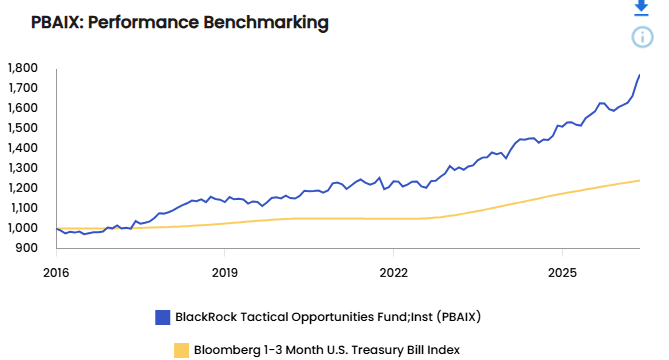
The fund has beaten its less than ambitious benchmark of T-bills.
- Nicolas says this is fine since it’s an alternative fund designed to offer uncorrelated returns.
A returns-based factor exposure analysis shows time-varying betas to countries, sectors, bonds, currencies, and commodities. The idiosyncratic risk is large because we can’t explain much of it (R2 of 0.52), which is expected for a fund that trades tactically.
The fund makes for a decent diversifier, along the lines of T-bills, but doesn’t offer great drawdown protection.
Nicolas says that the tactical switches mean that accurate replication is difficult, but the performance is similar to an 80/20 portfolio (which would have had lower vol and higher Sharpe).

So it’s an interesting fund, but only a small allocation might be warranted.
Conclusions
So that’s ten emails analysed (and another five skipped over), and we’ve reached thirteen hundred words.
- It’s been enjoyable for me, but the worrying thing is that I’ve only covered two months’ worth of emails.
I will probably repeat the exercise, but it won’t be every two months, so I have two options:
- Cover more emails (and write a longer article) or
- Be more picky about the proportion of emails that I cover.
The latter sounds like my favourite from here.
That’s it for today.
- Until next time.
Mike Rawson

Mike is the owner of 7 Circles, and a private investor living in London. He has been managing his own money for 40 years, with some success.