
Irregular Roundup, 28th September2026

We begin today’s Irregular Roundup with the Budget.
The Budget
Healy’s first budget turned out to be a 98-point nothing burger.
- It’s a Martin Lewis budget, with lots of tricks to save a tenner, and nothing to solve the real problems of life.
One can only assume that all the cans are being kicked down the road because we will have an election in the Spring.
- God help us if this tactic works out for Burnham.
“Do no harm” sounds like a good idea, but not when the country is already in a massive hole.
- We need growth, and we need to spend less, but these are not things a Labour government can deal with.
- We also need energy security, but Net Zero trumps that (just as social security trumps national security).
Instead we got another rise in the minimum wage, which is now £27.5K for 40 hours a week (higher rate tax kicks in at £50.3K, for at least another five years – this is the real tax rise).
- And another housing scheme (“Your First Home”) to prop up prices and housebuilder profits.
- And more “windfall” taxes on banks.

We didn’t get any CGT rises, but we did get an extra 2% on non-job income (above last year’s 2% from Rachel).
- The VCT tax-relief cut wasn’t abolished, but the cut in the Cash ISA contribution limit was.
- We also got a new Founders’ CGT break, but it’s so tightly drawn that almost no one will qualify (and Entrepreneur’s Relief was cut to £500K).
Fill those ISAs and SIPPs, boys and girls, and get out of (non-company) BTL.

The tax take and government spending are now at peacetime highs, and will only go higher.
- And the government’s deficit reduction plan depends on massive spending cuts in the last year of parliament – there is zero chance that Labour MPs will wave these through.
As you would expect, the problem of the state pension passing the personal allowance has been “solved” in the most complicated way possible – a new allowance for a small group, and a corresponding extra tax rate above the ceiling for qualification.
- It would be simpler to increase the allowance for everyone.
We also have another definition of “rich”, to go along with pensioners earning £35K (winter fuel allowance), others earning £100K (child care and the personal allowance) or owning a £2M home (the mansion tax).
- Add living in a home with a council-tax band above D (energy rebate) to the list.
Still, 4p off gherkins, eh?

Triple Lock
The end of the triple lock was announced before the budget. The spin on this divisive measure (popular with the old, hated by the young) is that it will bankrupt the country, but state pension costs are easily controlled by raising the state pension age – the SPA for women has gone up by seven years in recent decades.
I have two other objections to the removal of the link to wages.
- We have the lowest state pension of any rich country.
- The UK pension is 22% of working earnings, compared to 39% in the US, 58% in France and 76% in Italy.
- We also pay pensioners for fewer years (20, compared to 24 in Japan and 26 in France).
- And we spend less on the pension than other countries (4.7% of GDP, compared to 6.6% in the US, 12% in France and 12.8% in Italy).
- The savings from the end of the triple lock will not come close to paying for Burnham’s proposed National Care Service, which is in itself a very bad idea (see above – the country needs to spend less, not create another bottomless pit modelled on the NHS).
Shovel Rush
Next, a few words on developments in AI over the last couple of months.
- I think a catch-up is warranted as the AI bubble looks as though it might burst any day now.
In his “Back of the Mind” newsletter, Dan Davies looked at what’s really going on in AI:
I’ve been saying for a while that it’s definitely a sign of something that companies which had previously been claiming to be on the path to AGI are now renting out their spare compute to companies which are actually capable of credibly claiming to be expanding the frontier.
And he’s figured out why – there’s a lot of money in it:
SpaceX is renting out the Colossus 1 data centre to Anthropic for $15bn a year. I think it’s very hard to justify anything more than $500m a month ($6bn a year) for electricity, security, maintenance, the whole shebang.
I have not seen any estimate of its construction costs that was above $13bn, and let’s say for the purpose of argument that it’s got a depreciation life of five years (and so you allow $2.6bn a year for that).
Which means SpaceX is making $6.4bn a year on a $13bn asset – a 50% ROI. Of course, it’s risky:
Nassim Taleb’s proverb – “you often see a glut that isn’t followed by a shortage, but it’s very rare to see a shortage that isn’t followed by a glut”. A 50% ROI on data centres will last for exactly as long as there’s a global shortage of the relevant chips.
Also, the money is coming from investors, not end users:
Anthropic in Q2 was making a profit of $559m; if we assume that this doubles, then doubles again, then it’s still not reaching the $1.25bn a month in lease payments.
This is still a shovel rush rather than a gold rush – the amount of money that actual end-user customers are prepared to pay is nowhere near the levels that would be needed to support the capex.
Hyperscalers
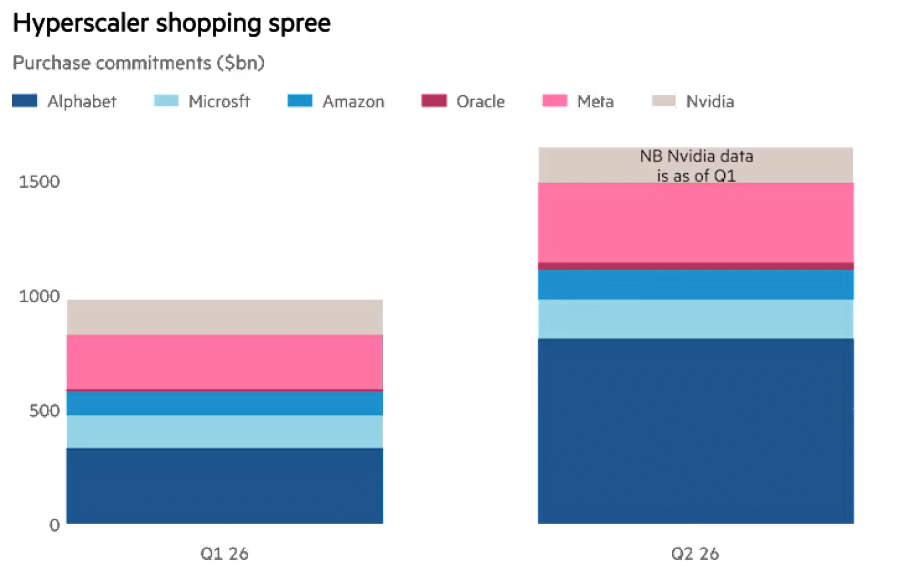
In the FT, Robin Wigglesworth had a couple of articles looking at the hidden leverage and purchase commitments of the AI hyperscalers.
Despite the recent bond issuance splurge, hyperscalers have an average net leverage ratio of just 0.5 times, compared to 0.8 times for the technology sector as a whole, and 1.8 times for (non-financial) US companies in general. Most eye-catchingly, they have more cash than debt.

But some debt is off the balance sheet:
Meta formed a joint venture with Blue Owl called Beignet that would develop and own Hyperion [a data centre]. Meta owns just 20 per cent of Beignet, but made a rock-hard commitment to lease Hyperion for at least 20 years.
That guarantee allowed Beignet to issue an amortising $27 bn bond, but this debt doesn’t actually appear as debt on Meta’s balance sheet, even if it is on the hook for the payments.
Apparently there’s now $1trn of this stuff, out of $1.5trn of hyperscaler lease commitments.
‘Uncommenced’lease commitments are not reflected in the financial statements, even though they will result in future lease payments (or other obligations) in upcoming years.
Five years ago, lease commitments were “just” $200bn.

Then there are promises to buy computing power, chips, equipment, and electricity. These purchase commitments do not appear as conventional debt on a balance sheet either.
NVIDIA
There’s been good news and bad news from NVIDIA. The firm announced a 2,400% dividend increase, which will make it the second-largest dividend payer in the US (after Microsoft),
But then Jeremy McKeown from Hypernormal Times reported that Jensen Huang has unveiled a fix to the nagging fear that AI has been inflating a bubble with circular financing:
It’s the most 2008 thing markets have seen since, err, 2008. A coalition of Wall Street’s biggest names, BlackRock, Goldman Sachs, six firms in all, are lining up more than $500 billion to finance the build-out, with the loans backed by Nvidia’s AI hardware and Nvidia itself standing behind up to a quarter of each deal through what it calls a “residual-value support Mechanism.”
This also sounds like the MBSs and CDOs from the housing bubble that triggered the 2008 crash:
It is a pool of loans secured against a depreciating asset, sliced and sold to yield-hungry investors, with the originator providing a partial backstop and Wall Street’s biggest names stamping the paper as sound. Larry Fink compared this moment to the birth of the mortgage-backed market in the 1970s, as a selling point.
Others were not so positive:
Morgan Stanley called it “circularity lite.” And Michael Burry, who shorted the actual subprime machine and who is now short Nvidia, said, “Structuring credit is a natural part of the system. Structuring unnatural credits to prolong momentum late in the bull phase is where the worry comes in.”
The argument is that any failing data centre tenant would soon be replaced, as long as the overall build-out is still proceeding.
- Which is just another way of saying everything is fine as long as the boom lasts.
And loan rates are heading higher:
CoreWeave borrowed this month at over 9%, junk bond territory, having marketed the deal more than a point tighter. Galaxy Digital paid nearly 10% for a data centre it leases to the same CoreWeave. AI-related issuance has hit $344 billion this year, up more than $200 billion on 2025.
An earnings melt-up, partly built on marking up your own investments, exists next to a credit boom built on guaranteeing your own customers. The house is increasingly being valued by the people who own it.
But as with every bubble, as long as the music is playing, you’ve got to get up and dance.
RP Ruckus
Justin from Risk Parity Chronicles reported on a kerfuffle in the finance blogger/podcast space over just how useful Risk Parity is.
- The critique was from Karsten Jeske of the Early Retirement Now (also known as Big Ern).
Karsten is best known for his mammoth series on safe withdrawal rates (SWRs) in retirement, but he also has a sideline in explaining how to sell options for income (the strategy works best in the US).
Provocatively, the post is part of Karsten’s “How to ‘Lie’ with Personal Finance” series, and the target is Frank Vasquez of the Risk Parity Radio podcast.
Personal relationships are also involved:
- Karsten and Frank appear to have fallen out on a recent podcast episode I haven’t heard.
- Justin’s blog came about because Frank didn’t want to write one and Justin wanted to preserve all the good ideas from Frank’s podcast.
I also think that a lot of the arguments are semantics – RP is used very loosely by finance bloggers, and you can choose a flavour to suit whatever point you are trying to make.
- Justin spotted this too, and changed his perspective on explaining the misunderstandings.
Karsten took objection to the idea that RP increases SWRs – his territory, after all.
- He advocates 100% equities during accumulation and a 75/25 stocks/bonds portfolio during decumulation.
I used to target 75/25 too (for both accumulation and decumulation), but I have always been interested in diversification.
- I had moved closer to a 70/15/15 (15 in alternatives) even before the 2022 crash reminded us that bonds don’t always protect against stock crashes.
Justin likes 100% stocks in accumulation and something between 75/25 and 60/40 in decumulation.
- Note that he uses lots of diversifiers like me, not just bonds – particularly trend and gold.
- He points out that ERN’s research made him include gold (as it did me) even though ERN himself did not add it.
Justin ran a quick test to show that his decumulation extremes stand up to ERN’s plan.
- 75/25 with a range of diversifiers looked best.
As usual, higher CAGR usually means slightly worse volatility and drawdowns.
He also notes that return stacking (capital efficiency/leverage) can make things even better.
- This is something I’ve been implementing in my portfolio over the last few years.
Jordan Grumet from The Purpose Code took a different angle on the brouhaha.
Predicting the future is impossible. It is a fool’s errand. The future is a leap of faith. Spending down your portfolio and retirement decumulation are leaps of faith.
Nobody knows the best portfolio until the period in question is over (and then it’s too late).
- So we focus on the process and making the right choices.
We have two tools, neither of them perfect:
- Backtesting
- Simulation (eg., Monte Carlo)
Jordan offers two different questions:
- Which plan are you more likely to stick with?
- Which one will allow you to sleep at night?
I think we can break the process down into smaller problems:
- What level of volatile equities can you tolerate?
- Which diversifiers do you believe in, and how many can you handle?
For me, the answer to both questions (and many others) is “as much as I can squeeze in”.
I don’t know anyone running a true RP portfolio. Most of us reference RP because it’s one of the central concepts that got us thinking about useful diversification.
- We all know that stocks are the growth engine, but there are lots of things you can put alongside them.
That’s it for today.
- Until next time.
Mike Rawson

Mike is the owner of 7 Circles, and a private investor living in London. He has been managing his own money for 40 years, with some success.