
Portable Alpha and The Magnificent Problem

Portable Alpha and The Magnificent Problem
Today’s post looks at a recent paper from Man on how to deal with the dominance of the Magnificent Seven.
Portable Alpha
The paper dates back to January 2025 and is called Portable Alpha: Solving the Magnificent Problem.
It tries to address the issue that beating the market in 2024 involved the risky strategy of overweighting the Magnificent Seven tech stocks (which are already highly weighted in the main indices). Man suggests portable alpha using multi-strategy and trend following as a possible solution.
In an early article (If It Moves, Monetise It!, which we will cover in another post), Man suggested that combining stocks with trend can increase (in fact, double) returns at the same level of risk. This is the classic example of portable alpha (PA).
PA splits the beta (exposure to the market) from the alpha (over- and under-weights to generate returns).
- The beta can be achieved through futures, swaps or other leveraged instruments, leaving room to “port” the alpha component to another asset class entirely.

The chart shows how portable alpha works by comparing the exposure of plain stocks to those from stocks plus a multi-strategy hedge fund and stocks plus trend.

The second chart shows performance and drawdowns over 25 years, from 1999 to 2024.
The portable alpha solutions generate higher returns over time despite having the same beta component. In simple terms, this is because we have two dollars invested for every one dollar in our traditional portfolio, and our ‘alpha’ components, multi-strategy and trend-following, both generate positive returns over time.
Further, the volatility of our solutions are not materially higher than the original 100% S&P 500 portfolio. This, of course, is because of the diversification provided by our alpha strategies.
These two points in turn lead to higher Sharpe ratios for the PA portfolios.
Drawdowns are slightly worse for the hedge fund portfolio, but better for the trend portfolio.

In addition, the table shows that the PA portfolios have kept up since the invention of the Mag7 term in Q2023 (and through 2024).
Drawbacks
A major criticism of PA is the potential for tracking error against the beta portfolio (in this case, the S&P 500).
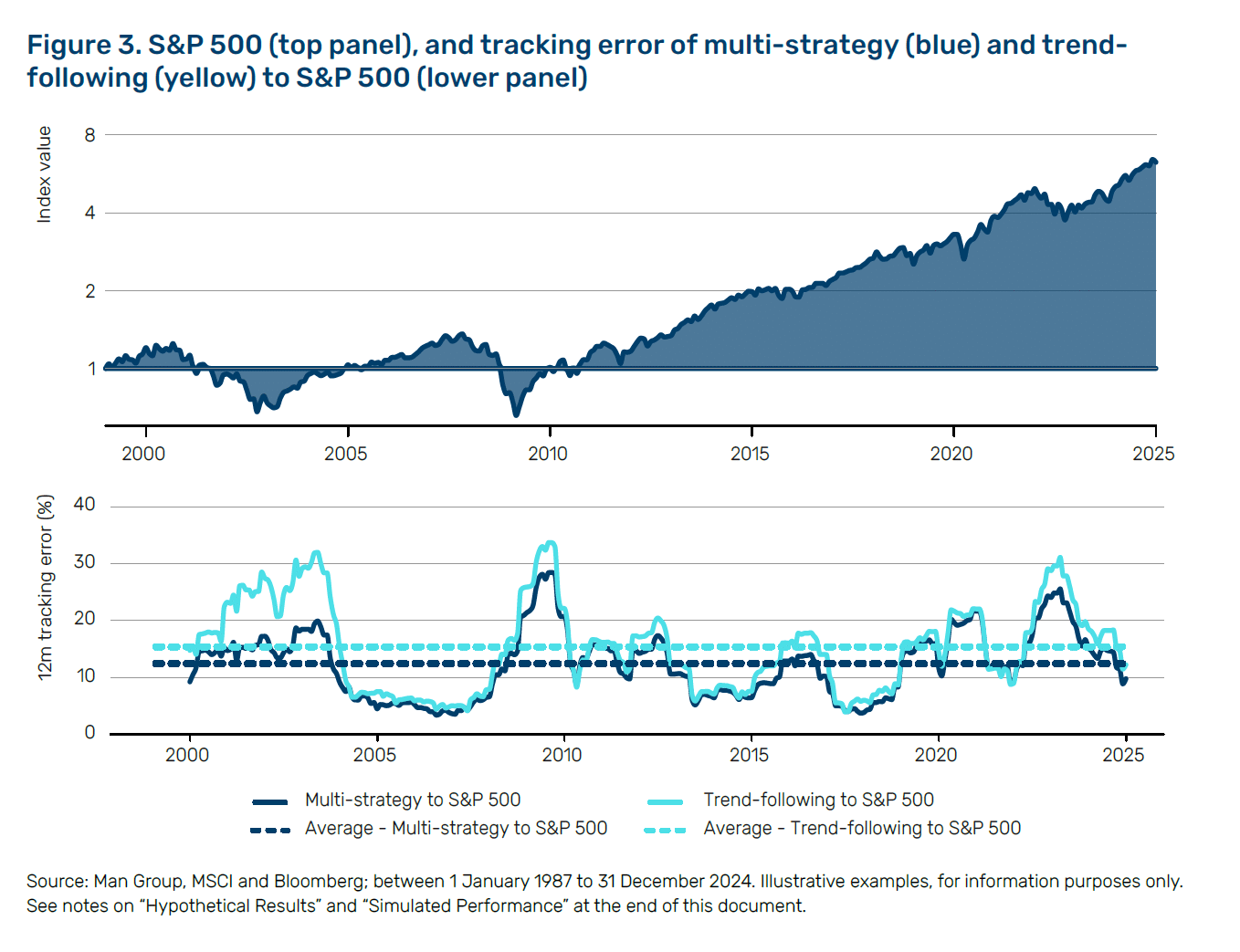
The tracking error of our multi-strategy index to the S&P 500 on a rolling 12-month basis is around 12% on average, at its lowest (~4%) during equity market rallies such as those leading up to the Global Financial Crisis in 2008, but peaks during drawdowns in the equity index.
However, this peak tracking error is largest when the portable alpha portfolio outperforms. This effect is amplified when we use the trend-following index instead of multi-strategy; during equity drawdowns, tracking error increases more, but again this is due to outperformance.
I think we can live with the good type of tracking error.
The paper also talks about cash efficiency (the ease with which we can generate 200% of exposure from 100% of investment), but this is not a problem for the two chosen PA portfolios.
Man also talks about liquidity:
Sod’s Law dictates that margin requirements are most likely to rise when markets are volatile, which is often when the alpha component is needed most. Ideally, if enough cash buffer is factored into the portable alpha solution, there should be no issues.
However, a worse scenario might occur if the alpha component is sufficiently illiquid that it can’t be sold down in the event of a margin call, leading to the enforced selling of the beta component. Investors need to know whether a chosen alpha strategy will pass this liquidity test. Ideally the strategy has ‘been there and done that’.
Conclusions
This is another simple paper in support of portable alpha portfolios, using either trend or hedge funds (or ideally, both) to complement stocks.
- Trend will be easier to add for UK private investors using tax shelters, but I’ll try to do both.
That’s it for today.
- Until next time.
Mike Rawson

Mike is the owner of 7 Circles, and a private investor living in London. He has been managing his own money for 40 years, with some success.